


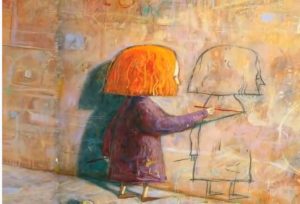
Image credits Shaun Tan’s picture book, The Red tree
While all of the poems, On sad afternoons, were written in private, for no one in particular but myself, they were arranged and edited in their present form for publication for a wider readership. And in that process of selection and organisation, I as the editor, sought to weave a metacognitive bubble over what I perceived to be a range of metacognitive bubbles, that I, as the writer, had precariously preserved within each of my poems. Each bubble carried within its self, a metacognitive moment, that I had paused to process and ponder upon in the space of a poem
Like a bubble
Within a bubble
And more
(Khan, 2021, p. 30, ‘Projections’)
And so, this blog post is about the difference between the bubbles of metacognition, that I, as an editor, and, a writer, negotiated in the writing of my poems, and, the publishing of this collection.
The best analogy that can explain the difference between the starting point for both, the writer and the editor, can be drawn through the words ‘Create’ or ‘New’ or ‘Open’ or the + sign, in contrast to ‘ Re-open’, ‘Edit’ and ‘Save’. And so while the ‘new’ beckons the writer to open, encapsulate and ‘save’ what is arrived at, this becomes the starting point for the editor to ‘Re-open’ it. And so, what the editor re-opens is the metacognitive despair of a writer who seems to be continuously occupied with the task of grappling with the divisions, delusions and dichotomies found at every corner.
And as I write this, the writer within me begins to grow restless and wishes to push out of this page, the need to metacognitively make space for both bubbles. It does not matter to it that the editor encapsulates its creations from without and gives them some semblance of meaning. It is neither intimidated by it nor disturbed by the order in which it may manipulate them and make available to the world in its finished form. For it is not interested in how it is preserved, but, only in the time that I make for it. It seeks the respite I give to it ‘from the daily grind of a full life’ so it can step
In[to] the nooks and corners of a world
Which is hidden in the folds
Of a blank page
Which wraps [it] in
White
And gives [it] the blankness [it] need[s] to re-member.
And as [it does]
The layers begin to slowly
Peel away
And [it is] able to breathe in
The familiar ache and rawness
Of [my] bruised and battered authenticity.
(Khan, 2021, pp. 142 – 143, I Re-member)
And there ‘it’ is. The writer, fumbling in the brackets, lurking in ‘the margins’, eager to change and play with the versions that I, as the editor, have decided to ‘Save’ and submit as ‘Final changes’ for the final publication. And it is this illusive shape shifting of the writer, who, like the desert sands, first chooses to and then refuses to cling to what it has dwelt on that makes each poem, like
An icicle [that] does not wish to hold on to the burden of significance
Attached to it
And is happy to step out of someone’s contracted awareness
To spill, slip and slide into the infinitude of time.
(Khan, 2021, p.16, ‘Once upon a time’)
And so, the uncertain affirmations of hope and the playful dismissals of despair that are arrived at in many of the poems’ existentialist conclusions, define the metacognitive persona of the writer of this collection and keeps me wanting to return to its dim light and its bright darkness, like a moth to a flame.
I can see it. Smell it too. And it’s presence. Flickering yet steady, like a yellow scented candle, burning as it beckons.
Editing, however, demands that I look away from it. Over the course of the three short weeks that I edited and compiled the collection, I had to adopt a very different kind of metacognitive vigilance, and assume a semblance of order, control and clarity that was needed to sort, sequence and segment 60 poems in 5 sections of 12 poems each. And while the editor in me tried to ‘save’ the scent, in the structure and sequence of this collection, On sad afternoons, I am not so sure if I was able to.
Are you able to trace the scent that is scattered across the collection, that I, the critic, have now stepped in to make visible to you, my dear reader?
And so, just when I thought there were only two of us in it, there comes the third. While you may not question the authorship of the book, I can see myself splitting three ways: The writer, the editor and the critic.
And each is . . .
Waiting for me
To prick my finger
Over the sharp needle of the very spindle
With which I’ve spun them
And each time I do
A bubble bleeds
And I awaken to a world
A hundred years behind.
(Khan, 2021, pp. 30-31, ‘Projections’)
Pingback: Defending Poetry: The Blue Butterfly - Sadaf Khan
Pingback: I am here, I am Australian. - Sadaf Khan